
Illustration
Published by Bird Control NYC.
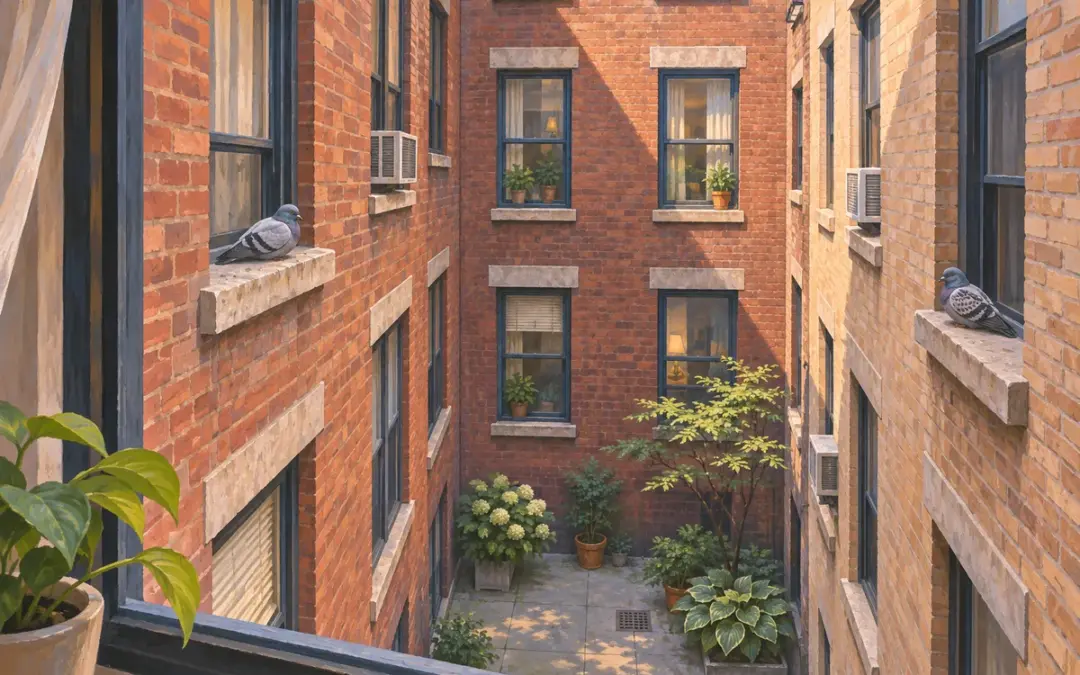
In a shared courtyard or airshaft, several residents may notice the same bird activity from completely different angles. Someone sees a perch from a bedroom window. Someone below notices droppings. The superintendent can see only part of the area from a ground-level doorway.
Those views can help build a useful picture, but they also make coordination important. Before anyone chooses a solution, the people involved need to agree on the location, the available access, and who is arranging the next step.
Give everyone the same reference point
Start with a simple description or sketch of the affected area. Label recognizable features, such as the rear entrance, laundry-room window, or upper ledge facing the courtyard. Mark where activity has been observed without guessing about hidden spaces.
If safely available, include dated photos from permitted locations. Written observations are useful when photos are unavailable. Keep each photo paired with a note explaining where it was taken and what it shows. A photo of a ledge without a location can create more questions than it answers.
If several residents report the same spot, combine their observations into one record while keeping distinct locations separate.
Find the contact for each space involved
A courtyard may look like one continuous area while access is managed through different doors, apartments, or properties. Ask the building manager who coordinates the affected space and whether another property contact needs to be involved.
Choose one person to gather questions and circulate agreed information. That person does not need to diagnose the problem. Their job is to keep the location, appointment details, and outstanding questions consistent.
Avoid assuming a neighboring building has agreed to participate. Give its staff a clear location description and any safely available photos so they can determine whether their space or access routes are involved.
Map the route, not just the problem
A contractor needs to know how an area can be reached as well as where birds are gathering. List the possible entry points and the person authorized to arrange each one.
Useful access questions include:
- Is the courtyard reached through a common hallway or a private unit?
- Which doors are locked, and who can open them?
- Are there building-specific restrictions on visiting hours?
- Will residents need advance notice about the agreed visit?
- Does viewing the area require coordination with another property?
Do not send residents into an airshaft or onto exterior ledges to investigate. Let the contractor assess whether the available access is suitable and identify any limitations.
Review the whole affected area
Ask the person assessing the site to explain which observed locations are included in the proposed scope. If only one ledge is being considered, make sure everyone understands that boundary.
Discuss how the proposal accounts for nearby windows, vents, drains, and spaces used for maintenance. Those features need to remain functional. Report any suspected nesting activity before scheduling work rather than covering openings or moving material yourself.
Also clarify whether other observed areas need separate assessment. This keeps a small proposal from being mistaken for a plan covering the entire courtyard.
Arrange a simple follow-up process
After agreed work is completed, keep the location record and scope together. Ask what follow-up observations would be useful and where residents should send them.
Encourage specific reports: the date, the exact location, and what changed. Birds flying through a courtyard and birds repeatedly settling on a treated ledge are different observations, so describe what happened rather than simply saying the problem remains.
Coordinating access can take a little effort, but a shared record gives everyone a clearer starting point. To discuss bird activity in your courtyard or airshaft, contact Bird Control NYC with location details and the access information your building has confirmed. Photos are helpful, but optional.
For related service information, see our bird control for property managers.
Browse more Bird Control NYC resources.
Need help with a bird problem?
Send photos and get a practical next step.
Tell us what you are seeing around the ledge, roofline, vent, solar panels, balcony, terrace, droppings, or nesting area. Bird Control NYC can help identify the issue and recommend a humane deterrent, cleanup, or exclusion plan.
Recent Comments